Fiscal Policy Knowledge Graph & Search Engine
Jun 1, 2018
·
2 min read
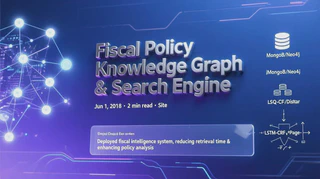
Project Background:
- Designed and led the development of a fiscal intelligence system for Zhong Jin Suo, focusing on policy document retrieval and intelligent recommendation.
- Objective: Solve inefficiencies in policy document search and enable deep policy analysis via knowledge graph technology.
Data Collection & Processing:
- Built a policy crawler system for scheduled acquisition of fiscal and tax policy documents.
- Structured storage in MySQL and MongoDB; full-text indexing in Elasticsearch.
- Entity & relation extraction:
- Word2Vec + K-Means for entity discovery.
- N-Gram + top-down taxonomy construction for category-label hierarchy.
- LSTM-CRF for fine-grained entity-relation extraction.
Knowledge Graph Construction:
- Ontology modeling (services, industries, regions) based on OWL.
- Implemented ontology query with SPARQL; developed region recognition interface for geographic tagging.
- Knowledge graph stored and visualized in Neo4j.
Modeling & Optimization:
- Multi-level policy association graphs:
- 2-level association graph for related policies.
- Tree-structured hierarchy graph (central, provincial, municipal levels).
- Recommendation:
- Similarity-based: Jaccard similarity.
- Hot policy discovery: PageRank centrality.
- Community detection: Louvain algorithm for policy domain clustering.
- Path discovery:
- Maximum Spanning Tree (MST) for strong relationship tracing.
- Dijkstra algorithm for shortest policy association path analysis.
- Policy Q&A:
- RASA-based intent recognition and slot filling.
- Query templates mapped to Elasticsearch/MySQL/Neo4j.
Workflow:
- Crawl and parse policy documents, store in databases, index in ES.
- Extract entities and build ontology-driven knowledge graph in Neo4j.
- Implement multi-level association queries and recommendation algorithms.
- Provide Q&A services for fiscal indicators using dialog framework.
- Visualize policy relationships and enable in-depth policy analysis.
Project Outcome:
- Successfully deployed the Fiscal Intelligence System, commercialized and sold to government and enterprise clients.
- Reduced policy retrieval time drastically, enabling policy analysts to discover associations and insights efficiently.
- Significantly enhanced fiscal policy research and decision-making processes through intelligent search and graph-based analytics.
