ZBJ Service Transaction Search & NLP System
Apr 1, 2017
·
2 min read
Project Background:
- Developed a service transaction search system for ZBJ.com, a leading service intermediary platform connecting enterprises with talent providers.
- Addressed challenges of long and noisy user search queries that affected category prediction accuracy and service recommendation.
- Aimed to improve search recall, class prediction, and revenue through automated text intelligence.
Data Collection & Processing:
- Source: User search logs and demand orders from ZBJ platform.
- Data cleaning: Removed special symbols, duplicated sentences, and irrelevant text.
- Text segmentation: Customized dictionary segmentation using Ansj.
- Labeling: Combined manual annotation with automated pre-labeling for named entity recognition (NER) and category classification.
- Data augmentation: Supplemented domain-specific vocabulary and knowledge from external sources (e.g., Baidu Encyclopedia).
Modeling & Optimization:
Named Entity Recognition (NER):
- Algorithms: HMM, CRF, LSTM-CRF.
- Training Tricks: CRF++ tool with feature templates (Unigram/Bigram), L2 regularization tuned via cross-validation, gradient optimization using L-BFGS, Viterbi decoding for sequence labeling.
- Challenges: Ambiguous token segmentation and unseen words; solutions included custom dictionary expansion and iterative corpus updates.
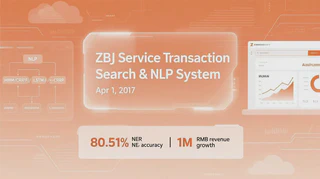
- Result: CRF entity recognition accuracy 80.51%, service category prediction improved by 6%.
Text Classification:
- Algorithms: Naive Bayes, CNN, RNN.
- CNN Implementation: Word embeddings (Word2Vec), convolutional kernels (length 2-8), max-pooling layers, batch normalization, dropout.
- RNN Implementation: Sequence padding, dropout on hidden layers, gradient clipping.
- Optimization: Adjusted hyperparameters including learning rate, batch size, hidden layer depth, neuron count, activation functions, and softmax output.
- Challenges: Class imbalance and likelihood distribution issues; solutions included data resampling, TF-IDF weighted class probability adjustment, ensemble voting.
- Result: Naive Bayes accuracy 90%, CNN 85%, RNN 87%.
Project Workflow:
- Preprocess user search queries and order texts.
- Extract named entities and keywords (themes, regions, industries, requirements).
- Predict demand category using ensemble of Naive Bayes, CNN, and RNN.
- Integrate prediction results to improve search ranking and recommendation.
- Apply results to self-operated business traffic optimization.
Project Outcome:
- Optimized search recall and recommendation, directly increasing self-operated traffic revenue by approximately 1 million RMB.
- Enabled precise matching between user queries and service providers.
- Provided a scalable NLP framework for ongoing search engine and recommendation system improvement.
